

Most brokerage API conversations start with a price sheet and end with a surprise. The number on the sheet is usually one line in a much longer budget, and the lines that are missing are often the ones that decide whether a product is viable.
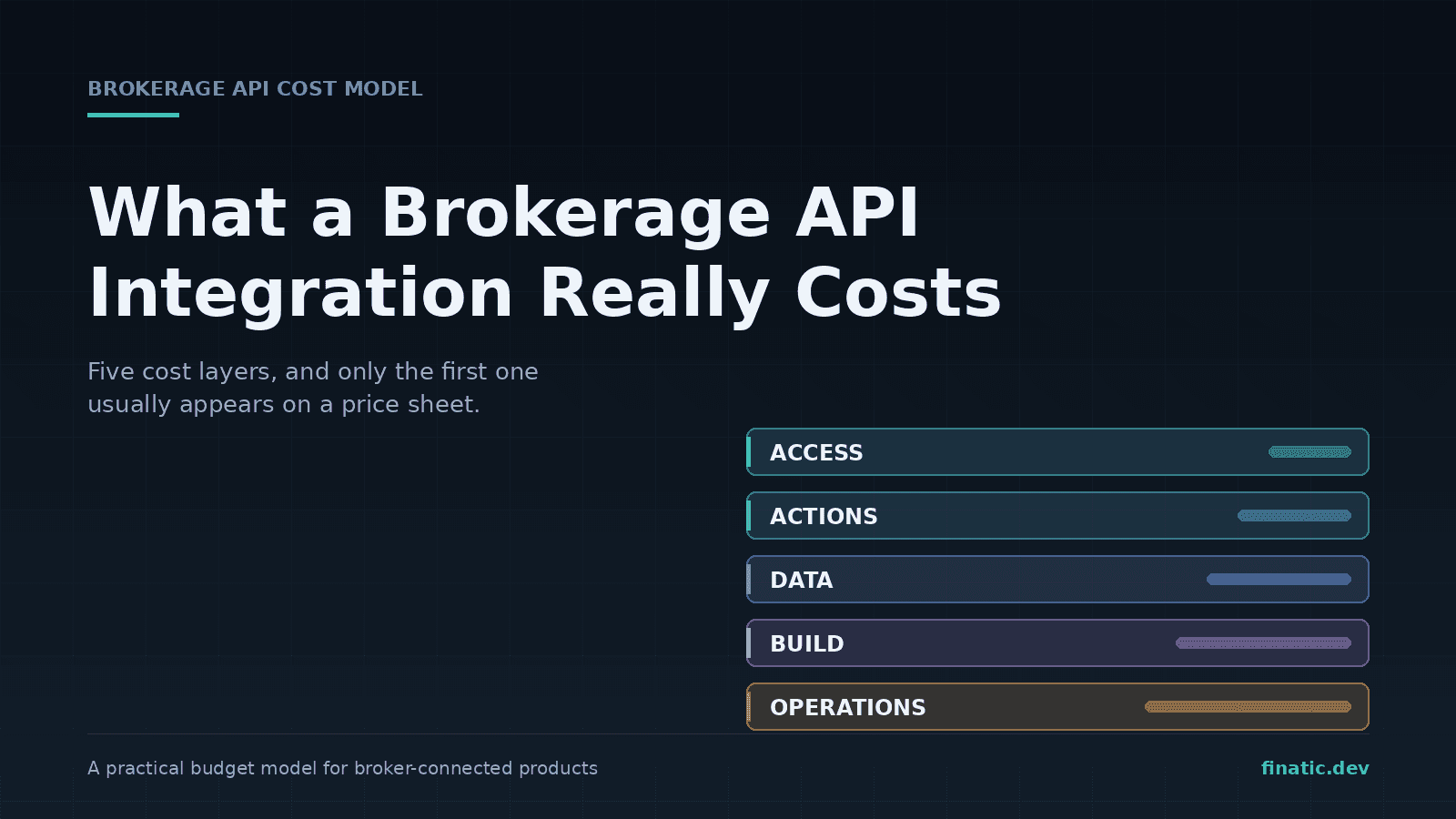
That is not a reason to distrust every vendor. It is a reason to price the whole workflow instead of the headline rate. A brokerage integration has five cost layers: access, actions, data, build, and operations. Each behaves differently as your product grows, and each can be modeled before you sign anything.
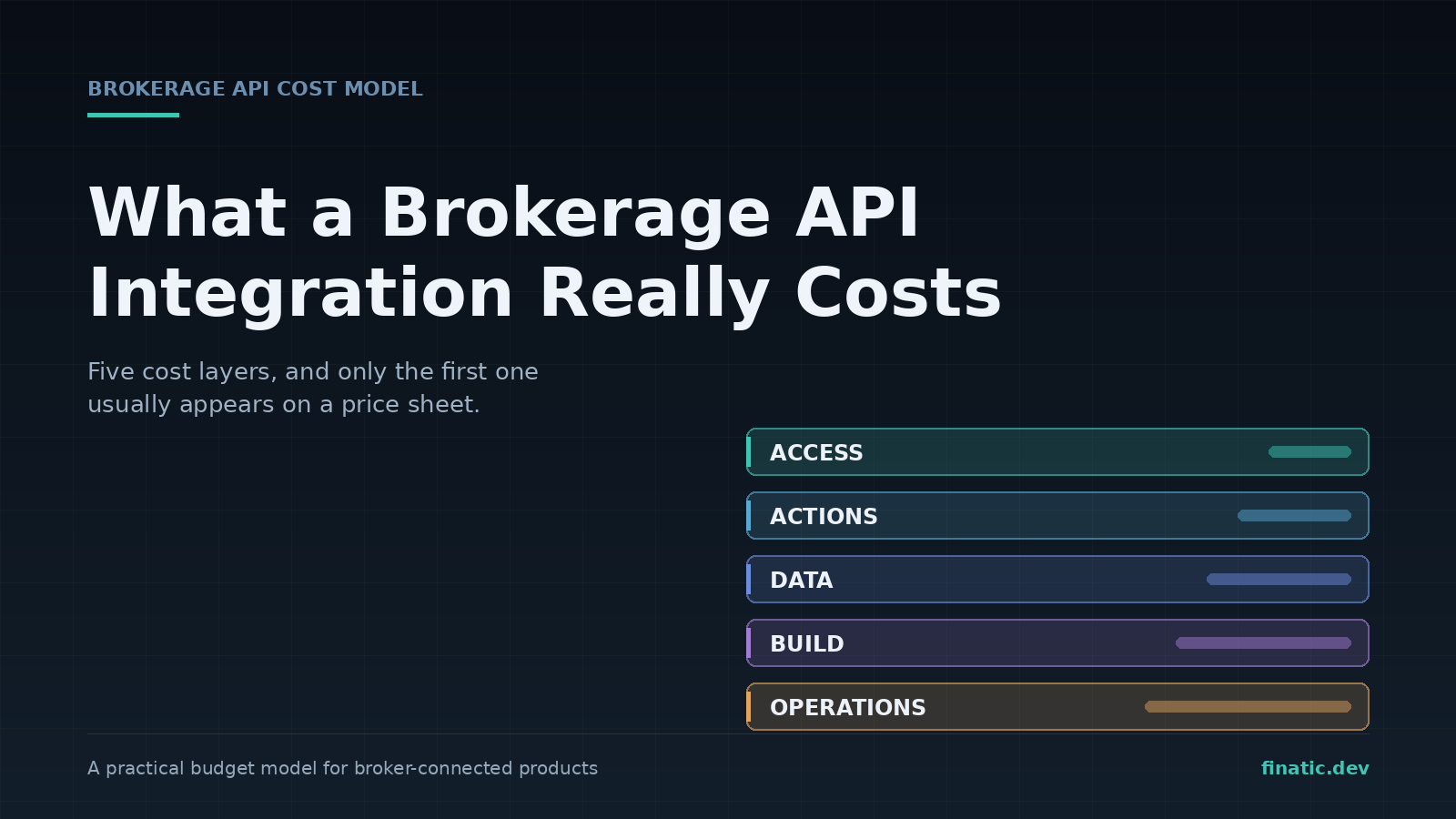
Caption: A brokerage integration budget has five layers, and only the first one usually appears on a price sheet.
The headline price measures one dimension
Brokerage APIs are rarely priced by a single unit. The common units are:
- Connected users — a monthly fee for each end user whose account is linked.
- API calls or requests — a fee per request or per bundled block of requests.
- Actions or orders — a fee per order placed, modified, or cancelled.
- Contracts or environments — a platform fee, sometimes split between sandbox and production.
Each unit rewards a different product shape. A portfolio dashboard with many linked accounts and few actions is cheap under per-order pricing and expensive under per-user pricing. A trade copier with a small number of heavy accounts is the reverse. The same vendor can look affordable or unaffordable depending on which unit your product stresses.
Before comparing vendors, estimate your own volumes in the vendor's unit. If you expect 4,000 connected users and 60,000 orders a month, write both numbers down. A rate that looks small per order can dominate the budget at volume, and a per-user rate that looks high can be trivial for a product with few, large accounts.
Layer 1: access and connection fees
Access pricing covers the right to connect accounts and keep them connected. It commonly appears as a monthly per-connected-user fee, a minimum platform fee, or a tiered subscription with a cap.
Three details matter more than the rate:
- What counts as a connected user. A user with three broker accounts may count once or three times. A user who reconnects after an expired token may be counted again. Ask for the counting rule in writing.
- What happens at the cap. If the plan includes 500 connected users, confirm whether overage is billed automatically, requires an upgrade, or blocks new connections.
- What happens on disconnect. Users churn, and stale connections accumulate. Confirm that disconnected accounts stop being billed and how quickly.
A free tier or sandbox is useful, but it is not a substitute for the production counting rule. The sandbox tells you whether the interface works. The counting rule tells you what the product costs.
Layer 2: per-action and order fees
If your product places, modifies, or cancels orders, action pricing needs its own model. Two questions decide most of it:
- Which actions are billable? Placing an order is the obvious one. Modifications, cancellations, and rejected orders often are not obvious. A rejected order can still consume an API call and a provider round trip.
- What happens during retries? Networks fail. If a request times out and your system retries, you want to know whether the retry is billed, and whether the vendor's idempotency support prevents a duplicate order.
Order volume is also the least predictable part of the budget, because it moves with market activity. A quiet month and a volatile month can differ by an order of magnitude. Model the volatile month, not the average one, and confirm whether there is any ceiling on charges.
Layer 3: data, custody, and pass-through licenses
This is the layer most likely to be missing from a price sheet, because part of it is not the vendor's to price.
- Market data. Real-time quotes, depth, and certain reference data are often licensed separately by the exchange or data vendor. Entitlements may be per user, per application, or per display type, and delayed data usually has different terms from real-time data.
- Custody and clearing. If your product touches account opening, money movement, or settlement, the custodian or broker-dealer may charge its own fees. Those are usually pass-through costs, not vendor margin.
- Regulatory and reporting. Some workflows carry reporting or record-keeping obligations that translate into vendor services, legal review, or operational headcount.
Ask every vendor which of these are included, which are passed through at cost, and which are simply outside the contract. A quote that excludes market data is not wrong, but it is incomplete, and the gap can be larger than the platform fee.
Layer 4: the build
The integration itself is a cost even when the API is free. A realistic build estimate includes:
- Authentication and token lifecycle. Server-side credentials, short-lived client tokens, refresh behavior, and revocation all need handling, plus the failure states around each.
- Identity mapping. Your product has its own user model. The connection layer has another. Deciding where the mapping lives, and how it survives reconnects, is design work that shows up in support tickets when it is skipped.
- Consent and linking UX. Users need to understand what they are connecting, what will be read, and what will be done with it. That flow needs error states, retries, and mobile behavior.
- Event handling. Webhooks or polling need idempotent handlers, ordering assumptions, signature verification, and a reconciliation path for missed events.
- Reconciliation and edge cases. Balances change, positions close, and providers disagree about timing. Someone has to decide which source wins and how the product explains a mismatch.
- Testing. Sandbox environments vary in fidelity. Budget for testing against real provider behavior before launch, not only against fixtures.
A useful estimate is not "two engineers for six weeks." It is a list of these workstreams with an owner and a rough size for each. That list also becomes the comparison basis between a direct integration and a connectivity layer.
Layer 5: the operating cost after launch
Integration cost ends at launch. Operating cost starts there.
- Provider drift. Brokers change endpoints, deprecate fields, adjust rate limits, and revise authorization flows. Every connected provider is a maintenance surface.
- Reconnects and consent expiry. Connections break for ordinary reasons: password changes, expired consent, revoked access. Each one is a user-facing recovery flow.
- Support load. "Why is my balance wrong?" and "Why did my order not appear?" are support questions before they are engineering questions. The better your product exposes freshness and state, the cheaper this becomes.
- Monitoring and incidents. You need to know when a provider is failing before users tell you, and you need a way to distinguish your outage from theirs.
- Coverage changes. Adding a provider is a project. Losing one is an incident. Both need an owner.
Teams often compare integration quotes and ignore this layer, then discover that the ongoing cost of five direct broker integrations exceeds the annual platform fee they were negotiating over.
Build the model, then compare
A simple budget model is enough to compare options honestly. For each layer, record the driver, the unit, your expected volume, and whether the vendor has confirmed the rule in writing.
| Layer | Cost driver | Unit to model | Question to settle |
|---|---|---|---|
| Access | Connected accounts or users | Monthly active connections | Does one user with three accounts count once or three times? |
| Actions | Orders, modifications, cancellations | Billable actions per month | Are retries, rejects, and cancels billed? |
| Data | Market data and entitlements | Entitled users or applications | What is licensed separately, and at what tier? |
| Pass-through | Custody, clearing, reporting | Per account or per transaction | Which costs are passed through at cost? |
| Build | Engineering and design | Person-weeks per workstream | Who owns identity mapping, events, and reconciliation? |
| Operations | Maintenance and support | Hours per provider per month | Who absorbs provider drift and reconnect volume? |
Fill the same table for each vendor and for a direct build. The result is rarely a single cheapest option. It is a set of tradeoffs you can defend: a higher platform fee against lower maintenance, or a lower rate against a larger engineering commitment.
Questions worth asking before you sign
- Can we test the full connection lifecycle in a sandbox, including reconnects and expired consent?
- How are credentials issued, scoped, rotated, and revoked, and what does the client receive?
- Are webhooks signed, retried, and ordered, and what is the documented reconciliation path?
- What is the error taxonomy, and which errors are safe to retry?
- What are the rate limits, and how are they enforced per user and per application?
- How does coverage change get communicated, and what notice do we get before a provider is removed?
- How do we export or delete user data when an account is closed?
- What exactly is billable, and can that be written into the agreement?
The answers matter more than the rate, because they determine how much of the budget lands in engineering and support instead of the vendor invoice.
Where a connectivity layer changes the math
A single integration changes the shape of the budget rather than removing it. Instead of maintaining one connection per provider, a product integrates once and works with normalized accounts, balances, positions, orders, and transactions, plus webhooks for order, transaction, balance, position, and account-change events where the connected provider supports them. Trading and order workflows remain permissioned by the connected provider and the user's consent.
That does not make cost disappear. You still pay for access, you still own identity mapping and reconciliation, and you still operate the product. What changes is the number of maintenance surfaces and the amount of provider-specific work in the build.
Finatic publishes its current plans on the pricing page, and current broker coverage is listed on the integrations page. Exact capabilities for a specific broker, including trading access and data freshness, should be confirmed for your workflow rather than assumed from a logo count.
Next step
Price the workflow, not the rate. If you are planning a brokerage integration, bring your expected connected-user count, order volume, data entitlements, and the provider list you actually need. Those four inputs are enough to turn a price sheet into a budget you can defend to your team and your board.
Talk to us about your integration and we will map the cost layers against your product's actual volumes.